single
channel version 09.38 mins /single channel DVD version 05.55 mins
4:3
HD limited edition / 3 + 10 screen 5.1 audio versions.
A Semiconductor film by Ruth Jarman and Joe Gerhardt made at the NASA
Space Sciences Laboratory, UC Berkeley, California, USA. 2006
Brilliant
Noise takes us into the data vaults of solar astronomy. After sifting
through hundreds of thousands of computer files, made accessible
via open access archives, Semiconductor have brought together some
of the sun's finest unseen moments. These images have been kept
in their most raw form, revealing the energetic particles and solar
wind as a rain of white noise. This grainy black and white quality
is routinely cleaned up by NASA, hiding the processes and mechanics
in action behind the capturing procedure. Most of the imagery has
been collected as single snapshots containing additional information,
by satellites orbiting the Earth. They are then reorganised into
their spectral groups to create time-lapse sequences. The soundtrack
highlights the hidden forces at play upon the solar surface, by
directly translating areas of intensity within the image brightness
into layers of audio manipulation and radio frequencies.
Awarded
second prize at Onion City Experimental Film and Video Festival 2006.
Awarded Best Video at Experimental Film and Video Festival, Seoul,
Korea 2006.
Thanks
to the following solar observatories whose data archives were used
in the making of this film: Mount Wilson Observatory UCLA, Lasco/SOHO
Naval Research Laboratory, TRACE/LMSAL, Big Bear Solar Observatory/NJIT,
SST/Royal Swedish Academy of Sciences, Gong/National Solar Observatory/AURA/NSF
Thanks also to: Steven Christie, Iain Hannah, the CSE team and all
at the space sciences Lab. UC Berkeley.
Early on in our fellowship we came across one still image of what
turned out to be the Sun. We were fascinated by this image and wondered
why we hadn't seen anything like it before. After some rooting about
we discovered there were archives full of these documents of the
sun but they required specialised knowledge just to extract each
individual still from the data package it was stored in. We set
about learning from the scientists the methods of extracting them
and over the course of three months we downloaded gigabytes of archives.
From here we turned these files into time lapse sequences according
to their spectral frequencies and the film Brilliant Noise began
to emerge.
The visual noise in the images is caused by natural and man made
interferences. The white noise is cosmic rays impacting the CCD
of the satellite camera, we also see frame dropouts and one frame
taken from a ground based observatory which shows the silhouette
of a plane as it crosses the path of the observatory. We wanted
to leave these flaws in as they reveal something about the tools
man uses to capture these images and makes them more tangible. These
disturbances are routinely removed by NASA to create a cleaner image,
they then go on to colourise them.
The sound is derived from solar natural radio and controlled via
digitally sampling the intensity of the brightness of the image.
The sound is intrinsically born from the image, creating a symphony
by the Sun.
By doing this we wanted to enhance the sun as natural phenomena.
Working with a documentary approach, we wanted to indulge in the
raw material that is our Sun, using the image to control the fluctuation
of the sound would emphasize the transitions and processes taking
place.
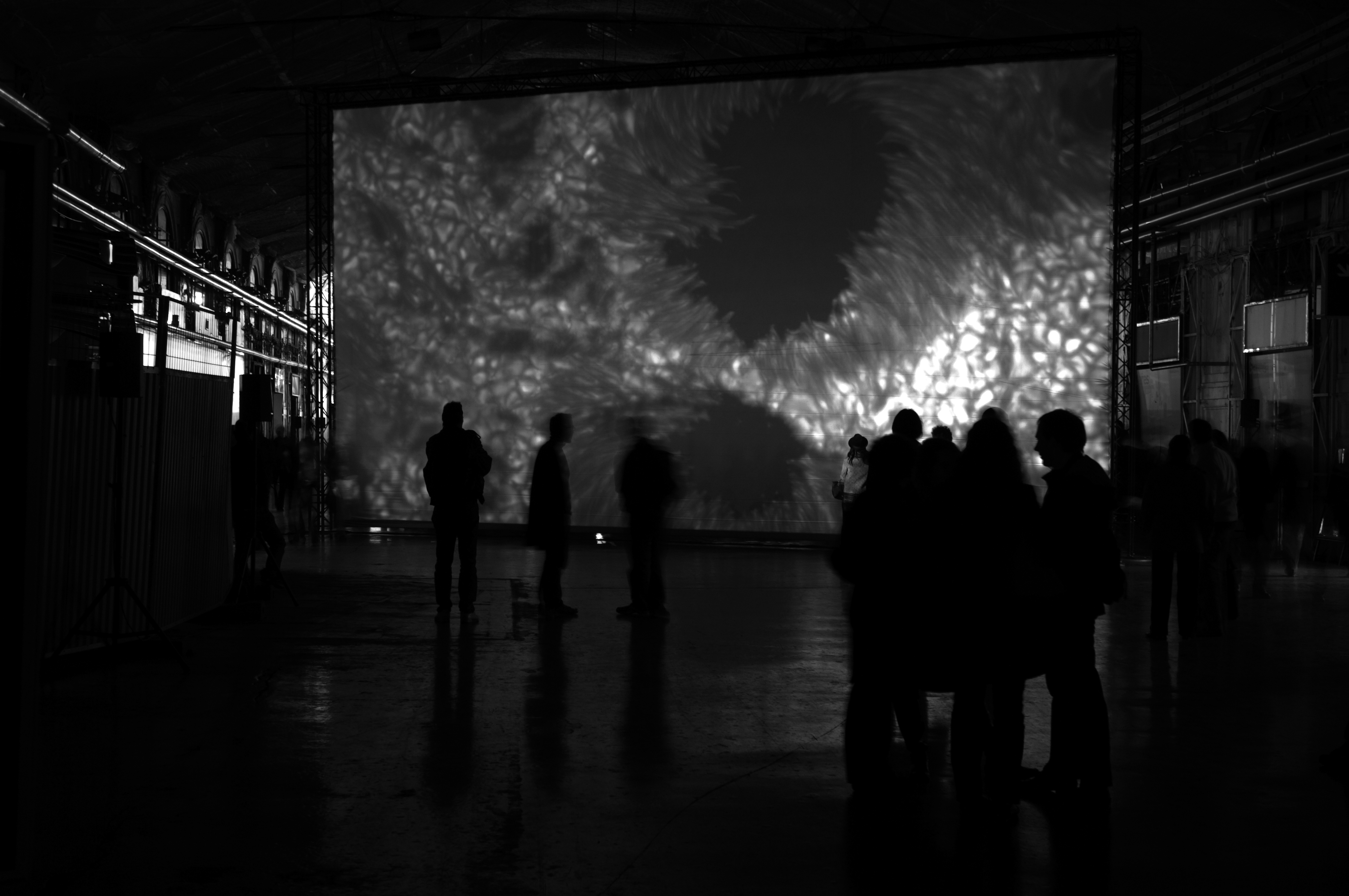
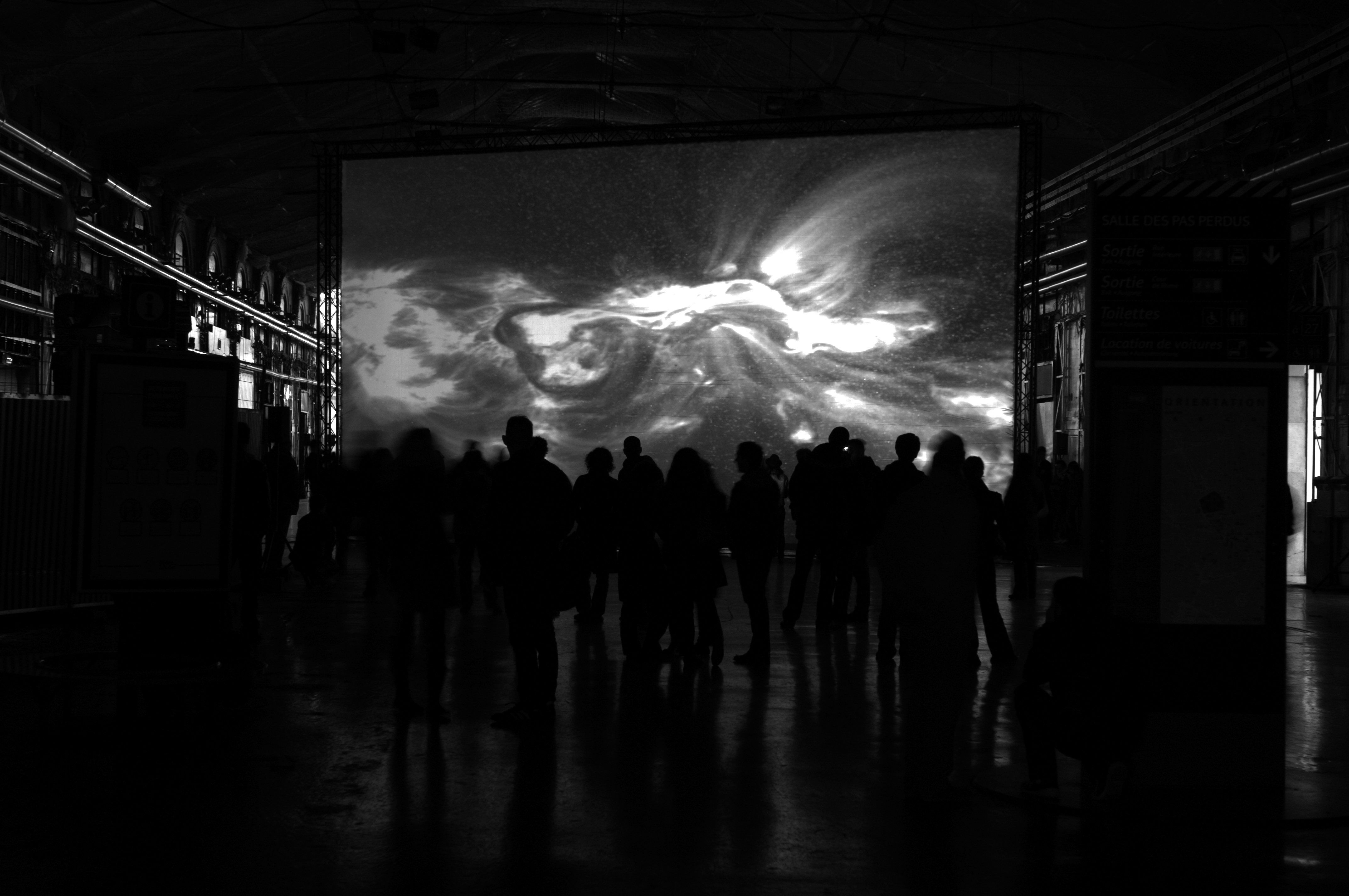
Semiconductor have developed Brilliant Noise as a multi-stranded
project; It exists as a single work and also as a multi-screen installation.
It has been installed as a 10 screen 16 audio channel work, and
as a three screen surround sound installation.
It is the feature of Semiconductors DVD release with Fat Cat Records,
Worlds in Flux, in the form of a soundtrack project. Semiconductor
invited sound artists and musicians to create alternate soundtracks
to the film resulting in eleven new or remixed works by:
Antenna Farm, Disinformation, Thomas Dimuzio, Ensemble, Gæoudjiparl,
Robert Hampson, Iris Garrelfs, Our Brother The Native, Max Richter,
The Twilight Sad, Cristian VogelIt also exists as a live performance
whereby the brightness of the image is sampled in real-time to control
live audio.
Brilliant Noise has also been performed as a single / multi screen
and HD work with live soundtrack.
Photographs below of Brilliant Noise installed
at Recombinant media Labs. San Francisco August 2006: